The Formative Period of Twelver Shi'ism by Andrew J Newman
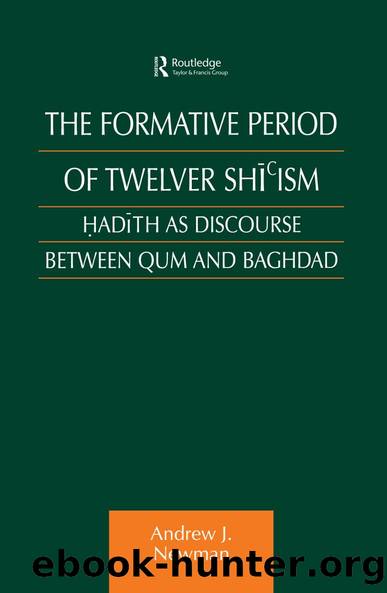
Author:Andrew J Newman [Newman, Andrew J]
Language: eng
Format: epub
Tags: Social Science, Ethnic Studies, General, Regional Studies
ISBN: 9781136837050
Google: vZeMAQAAQBAJ
Barnesnoble:
Publisher: Routledge
Published: 2010-12-22T00:00:00+00:00
The Centrality of al-Ê¿Aql and al-Ê¿Ilm: the Repudiation of Rationalism
That the presence, and yet precarious situation of rationalist discourse was foremost in al-KulaynÄ«âs mind is further attested to by his commencement, following his preface, of al-KÄfÄ« with traditions on al-Ê¿aql and al-Ê¿ilm, in which the former is put firmly in its place.8 Of the thirty-four traditions in KitÄb al-Ê¿Aql waʾl-Jahl, the collectionâs first book, Ê¿AlÄ« b. IbrÄhÄ«m b. HÄshim al-QummÄ« (died after 307/919) â the author of one of the first ImÄmÄ« tafsÄ«r works as well as Qurb al-IsnÄd, who narrated traditions from Aḥmad b. Muḥammad b. ʿĪsÄ and his own father, the latter deemed thiqa by al-NajÄshÄ« and one of the first to narrate Kufan traditions in the city â transmitted five traditions as did Muḥammad b. YaḥyÄ al-AshÊ¿arÄ« al-Aá¹á¹Är, also deemed thiqa by al-NajÄshÄ«.9 Al-Ḥusayn b. Muḥammad al-AshÊ¿arÄ«, also thiqa10, transmitted four, and both Ê¿AlÄ« b. Muḥammad b. Ê¿AbdallÄh al-BarqÄ« al-QummÄ«, the son of Aḥmad b. Muḥammad al-BarqÄ«âs daughter, and Aḥmad b. IdrÄ«s al-AshÊ¿arÄ«, who also narrated from Aḥmad b. Muḥammad b. ʿĪsÄ al-AshÊ¿arÄ« and was deemed thiqa by al-NajÄshÄ«, transmitted two.11 Al-á¹¢affÄr al-QummÄ« narrated but one. QummÄ«s accounted directly for a total of nineteen texts, or 55 per cent of the total of thirty-four. The AshÊ¿arÄ« directly transmitted eleven of the total of thirty-four, or 32 per cent. If one adds to the QummÄ«sâ transmissions the five texts transmitted by Ê¿AlÄ« b. Muḥammad b. IbrÄhÄ«m al-RÄzÄ«, who narrated traditions to SaÊ¿d b. Ê¿AbdallÄh al-AshÊ¿arÄ« and was deemed trustworthy by al-NajÄshÄ«,12 twenty-four texts, 75 per cent of the total, were narrated by local traditionists.13
Of these traditions, al-KulaynÄ« narrated several via Ê¿a number of our companions (Ê¿idda min aṣḥÄbina)â from Sahl b. ZiyÄd (28/34),14 and that cited from al-á¹¢affÄr was from Sahl as well (26/26) as were two other traditions (25/22, 23/16), the first of which was cited via the more reputable Ê¿AbdallÄh b. SinÄn. Al-Haytham al-NahadÄ«âs name appeared in another (26/27) and Muḥammad b. YaḥyÄ narrated a tradition from Aḥmad b. Muḥammad b. ʿĪsÄ al-AshÊ¿arÄ« (11/4). Mufaá¸á¸al b. Ê¿Umar (26/29), al-Ḥusayn al-NawfalÄ« (12/9)15 and Muḥammad b. SinÄn (11/7), all later declared to have been âproblematicâ narrators, also featured in the isnÄd of these traditions, the latter in a tradition narrated from an Ê¿idda associated with Aḥmad b. Muḥammad al-BarqÄ«.16
In these traditions al-Ê¿aql appears as the first of Allahâs creations which cannot be acquired by human effort but is only given as a gift and which, only through al-Ê¿ilm â the knowledge taught by the Imams â leads man to true knowledge, knowledge of Allah. Thus al-Ê¿aql and al-Ê¿ilm are constantly, and necessarily, paired for the believer; al-Ê¿aql alone is not sufficient without the Imamsâ Ê¿ilm, while without Ê¿aql Ê¿ilm cannot be recognised.17 Thus, in a tradition cited from Aḥmad b. Muḥammad al-BarqÄ« from his father, Imam JaÊ¿far stated that
between faith and unbelief there is only a paucity of Ê¿aql (28/33).
Al-KulaynÄ« cited, via al-BarqÄ«âs Ê¿idda via the same isnÄd, al-MaḥÄsinâs tradition in which Imam JaÊ¿far described Allah as creating
Download
This site does not store any files on its server. We only index and link to content provided by other sites. Please contact the content providers to delete copyright contents if any and email us, we'll remove relevant links or contents immediately.
Spell It Out by David Crystal(36117)
Life for Me Ain't Been No Crystal Stair by Susan Sheehan(35811)
Cecilia; Or, Memoirs of an Heiress — Volume 1 by Fanny Burney(32558)
The Great Music City by Andrea Baker(32018)
Cecilia; Or, Memoirs of an Heiress — Volume 2 by Fanny Burney(31956)
Cecilia; Or, Memoirs of an Heiress — Volume 3 by Fanny Burney(31941)
Professional Troublemaker by Luvvie Ajayi Jones(29662)
The Secret History by Donna Tartt(19088)
We're Going to Need More Wine by Gabrielle Union(19046)
Twilight of the Idols With the Antichrist and Ecce Homo by Friedrich Nietzsche(18632)
All the Missing Girls by Megan Miranda(16026)
Cat's cradle by Kurt Vonnegut(15353)
Pimp by Iceberg Slim(14506)
For the Love of Europe by Rick Steves(14121)
Bombshells: Glamour Girls of a Lifetime by Sullivan Steve(14075)
Talking to Strangers by Malcolm Gladwell(13370)
Norse Mythology by Gaiman Neil(13363)
Fifty Shades Freed by E L James(13240)
The Social Justice Warrior Handbook by Lisa De Pasquale(12190)
